Botanical Research + Education
Through the Ground Shots Project, we compile extensive ethnobotanical profiles for educational purposes based on field research and a deep dive into history, botany, archaeology, philosophy and current cultural conversations. Often a combination of these perspectives in one place is missing from herbalism or botanical literature.
We also explore these themes on the Ground Shots Podcast, an audio project exploring our relationship to ecology through conversations and storytelling.
We also teach classes in person and online in different format on plants and people, to find classes, go to our store page, here.
We’re here to offer something on the edges: resources that are cohesive in breadth, acknowledge a bigger ecological web that plants are a part, see the human as a part of ecology, and honor the complex cultural traditions of use that often span beyond perceived borders.
Through our podcast conversations and creative educational resources, we are offering a unique lens into the world of plants and the ways in which we can be connected to them in modern times.
Below are a few extensive profiles we have available free for the public:
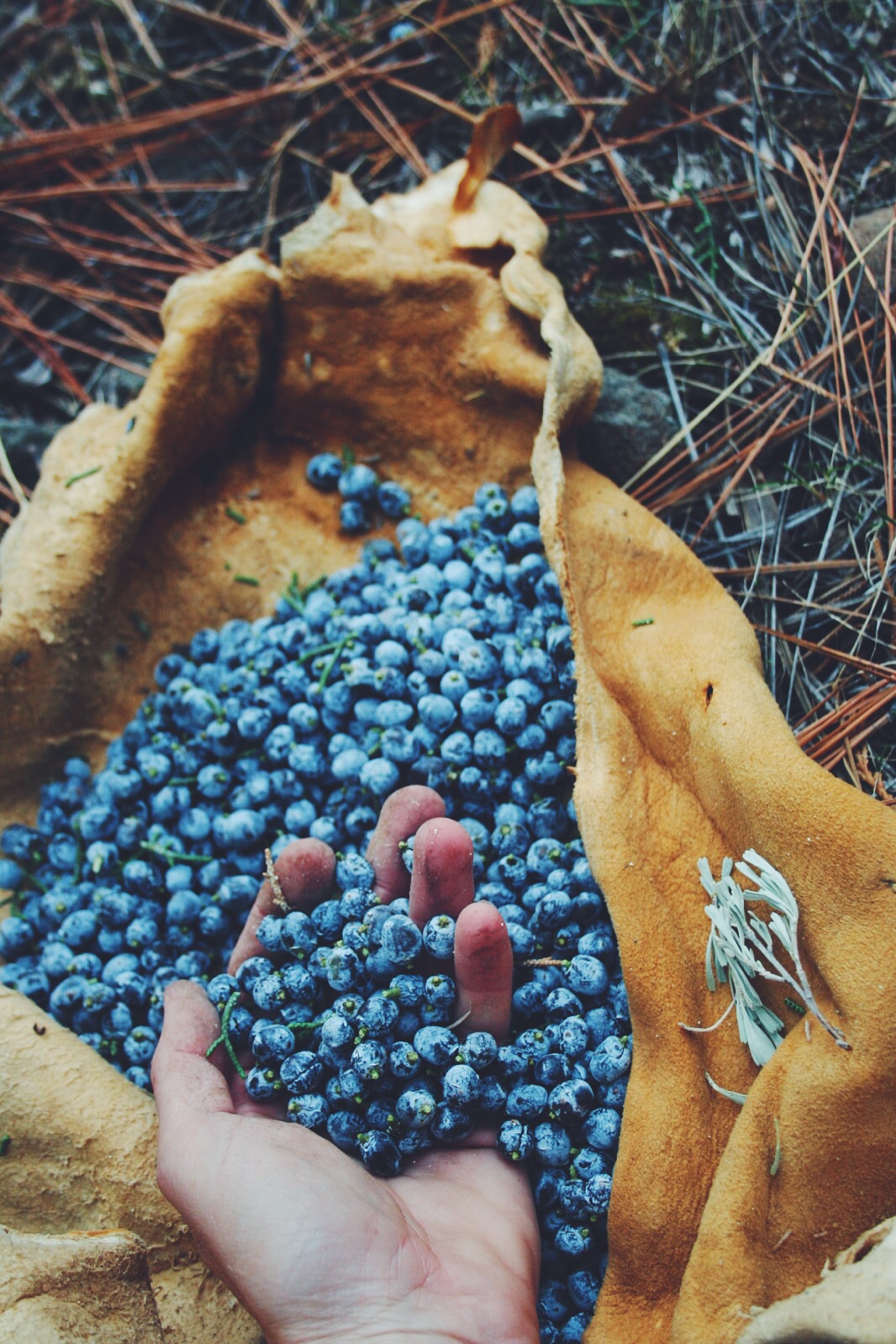
Junipers have a few distinguishing characteristics. They can be big trees, medium sized shrubs or found trailing along the ground. They can grow at pretty high elevation and extreme climates. Often the tree has needle-like or scale-like leaves. Needle-like leaves are most commonly found on younger plants, but sometimes old branches, and some species retain the needle-like leaves. The scale-like leaves are often found on juvenile leaves or older. I’m sure there is an adaptive advantage to having these different leaf types.

On the trail, going steadily uphill, I am followed by a murder of crows hopping from one Devil's Club (Oplopanax horridus) palmate leaf open handed to another. The car sounds disappear and I go deeper into to quiet dampness, and into the company of trees that have seen a lot of change these past 600 years. Ferns, Wild Ginger (Asarum caudatum), Wood Sorrel (Oxalis sp.), Salal (Gaultheria shallon) surround me. I put on my green fleece over my Black Walnut (Juglans nigra) and Yellow Dock (Rumex crispus) seed leaf-print dyed silk shirt made by a friend, and then take it off. On, then off. Movement much needed after a week and a half of being sick, I try to walk fast to get my heart rate up. I cry at the sight of the old Sitka Spruce, standing nearly alone towering over a younger forest, and this is even with half of its top having fell off in the 1950's. All around this elder (though this isn't actually old for what these trees should be) I find the 'Elder,' Red Elderberry, in fact. The one whose berries have been found in archaeological middens sites belonging to the long time native human inhabitants of the Pacific Northwest coast.

I remember the daily glass of Orange or Grapefruit juice I used to have with breakfast growing up. The sweetened and concentrated juices got poured in cold glass jars with ice. My mom would feed my sister and I half a Grapefruit each for breakfast sometimes, covered in sugar to mask the bitter flavor and paired with a special spoon that cuts around in-between the fruit and the white inner skin. Around Christmastime, Orange and Grapefruit would ripen in Florida, and the fruits would make their way up through the South and into local stores. It was common to get an orange in your Christmas stocking, a welcome fresh source of Vitamin C in the depths of winter. I also remember religiously coating my already straw-blonde hair with fresh lemon juice in the summer, sometimes leaving dried pulp in the strands in order to speed up the summer sun's lightening process. Often this left my then long strands snow white by August.
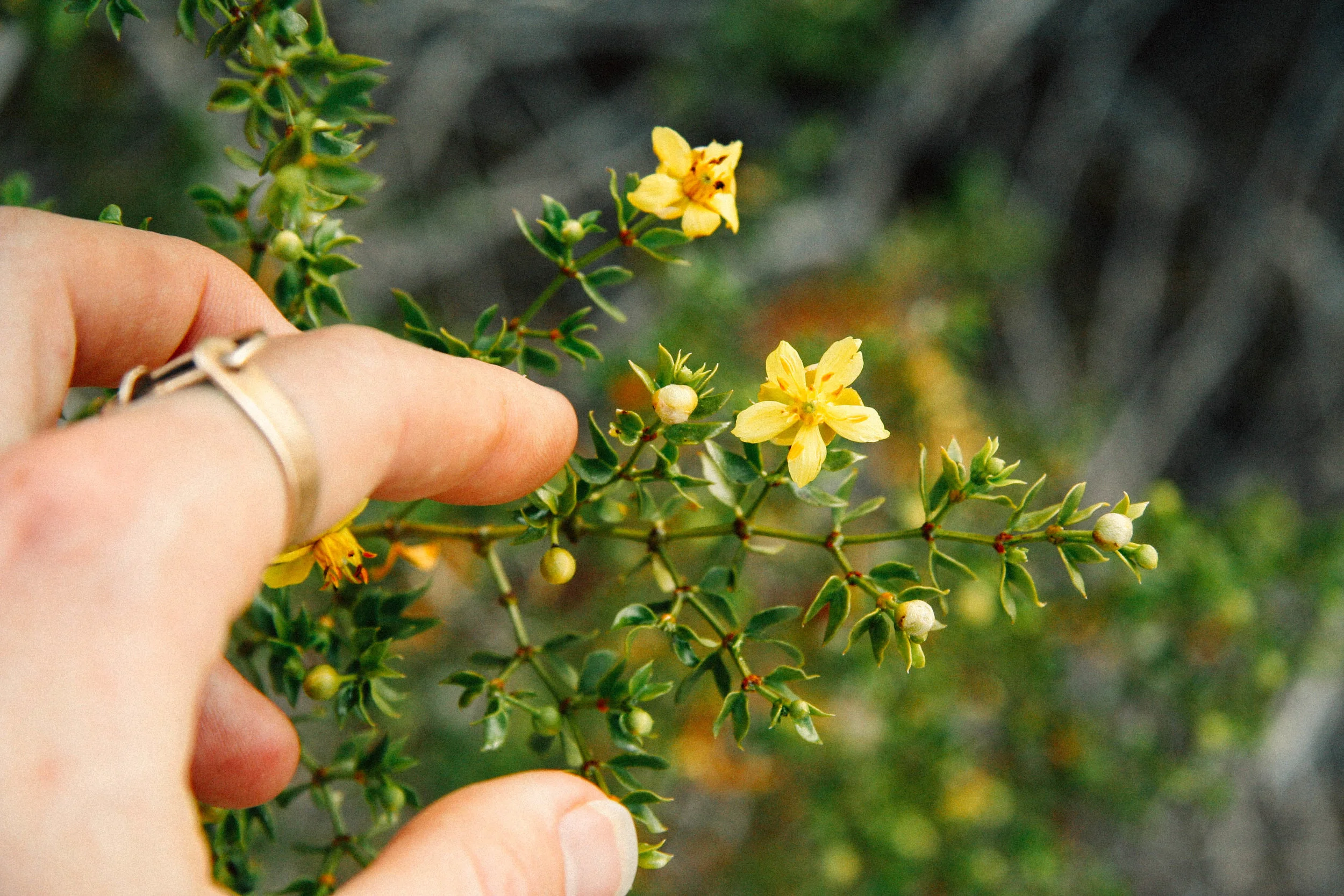
Larrea is also incredibly efficient at reserving water for itself due to harsh temperatures and long periods without rainfall in the desert. As with other plants that have resinous leaves, Larrea's are adapted to retain precious water for its photosynthetic needs. The resins protect the plant from the harsh environment, and it is these concentrated powerful resins that give the plant its greatest medicinal qualities. Mature plants are extremely tolerant of drought. Rising temperatures and recent droughts in the Southwest have actually increased its populations because of this plant's adaptability. When it does rain, the plant takes as much opportunity as it can to absorb the moisture, and the leaves and new branches almost feel succulent to the touch. When it is hot out and hasn't rained for awhile, you can approach one of these bushes and think that it is practically dead- even the newest of branches will break off with clear tree-limb like 'snap.'

While I harvested the flowers, berries, leaves and roots from this ever unfurling / scaling back / unfurling hedge of aromatic wonder woven between the living spaces of my cobb outhouse, the communal outdoor kitchen, our gardens and my cobb cottage home, I also spent just as much time 'cutting back' the 'chaos' being rightfully poked and prodded in return from the protective bramble. I'd spend hours in the humid air gloved covered in thick-canvased Carharts trying to carve paths into the center of giant groves to get the best berries, or cutting them out of and digging them up from the edges of garden beds we allotted for annual food or perennial herbs. I'd find enclaves where the birds made nests, or the deer made tiny beds to rest. I realized through this relationship with pokey and sharp brambles, and my tendency to stay away from parts of the farm that I could not traverse because of the thickets of prickle, that there was a purpose to these hedges.

I am unusually drawn to Cottonwood. The smell of the sticky golden resin that can be found on its buds, petioles, and sometimes leaves is one of my favorites that exist in our world. This love is so great that I wear a perfume made with Cottonwood resin as a base. I rub the salves I make from this plant on my skin and face just to feel what I feel when I smell it. Its a scent, like all scents, that ignites the bypassing of language and goes directly to that primal place of ancestral connection beyond just our human kin. Maybe I love it for that, for that immediate place it takes me, that kind of forget the small talk and the everyday menial sense of things and be in this feeling that our bodies are one part of a greater whole in time and space.

Yerba Santa is a plant native to California, parts of Oregon and other species are found in the Southwest usually found at lower or mid elevations. It was given the name we currently use meaning 'sacred herb' by settlers that came to the region and noticed it's regular use amongst native groups who had lived here for thousands of years.

Ceanothus is the genus of a group of plants in the Rhamnaceae or Buckthorn plant family. Several species in this genus go by the common name, Red Root.

Persimmon is a small tree with a luscious edible orange fruit, technically a berry. The word 'Persimmon' is an alteration of a word originally coming from an Algonquian language of the native Powhatan of coastal Virginia meaning 'dry fruit' due to its tannic skins. Persimmon is wild in the southeast United States, and a planted edible cultivar of the West coast. Different Persimmon species are also native to parts of Asia, and southeast Europe. Persimmon has a cultural tradition of use in many parts of the world including the Middle East, Spain and parts of the Mediterranean.

The Pinon Pine tree is responsible for the creation and survival of the cultures that inhabited the Colorado Plateau and the Great Basin as early as 6,000 years ago according to the archaeological findings of Pinon charcoal and nutshell remnants found in old cave dwellings (Lanner). This includes the Great Basin dwellers of Washo, Shoshone, Paiute and the southwest dwelling Hopi, Zuni, Pueblo, and Navajo. Bountiful Pinon shaped the creation stories, the physical objects of everyday life, and was the main source of food for Native peoples who dwelled on these lands, and still dwell on these lands. How each group and culture used and treated the plant varies according to location and time. There is no denying the importance of this tree, a fairly new inhabitant of the western deserts of the United States in geological time.

This is the fourth year that I will be making some version of what I was calling 'Desert Wound Salve' in the past. The plants I lend stories to here in this post are some of the plants included in the salve I make. I tend to collect stories in my mind of the plants I love, and want to make my medicine filled with stories and layers of connection.



The common name Blueberry can actually refer to a few different species of Vaccinium, and often Vacciniums are called Huckleberries or Bilberries depending on where you are, and some plants are Vacciniums but are not called either- like Cranberry.